


One state. Twelve counters. One condition standard.

- Inspections delivered
- 121,746
- Average inspection time, vs. 30–45 min manual
- 6 min 40 s
- Estimated counter time saved
- ~62,500 hrs
“Avis Alaska needed the same vehicle condition process to work at every counter, even when a rental started in one city and ended hundreds of miles away in another.”
The problem was consistency at statewide scale.
Different counters created different records
Avis Alaska operates 12 locations across the state, including Anchorage, Fairbanks, Juneau, Haines, Kenai and Skagway. Its one-way rental model means a vehicle can leave one counter and return to another, so the condition record has to make sense to people who were not there when the vehicle left.
Peak season made slow processes more visible
The existing process relied on manual walkarounds, paper and photo folders. During busy travel periods, every extra step added pressure at the counter. Different photo angles, notes and local habits also made it harder to compare pickup and return evidence across locations.
The team still wanted to own the judgment call
Avis Alaska did not need an outside system to decide what counted as damage or what a repair should cost. The team wanted a more consistent way to capture and organize condition evidence while keeping damage assessment and repair-cost estimation inside the business.
“The requirement: give all 12 counters the same inspection process while keeping damage decisions in house.”
Standardize the record, not the judgment.
Self Inspection became the capture and evidence layer. Avis Alaska kept the parts of the process it already knew best.
1. Give every counter the same capture flow
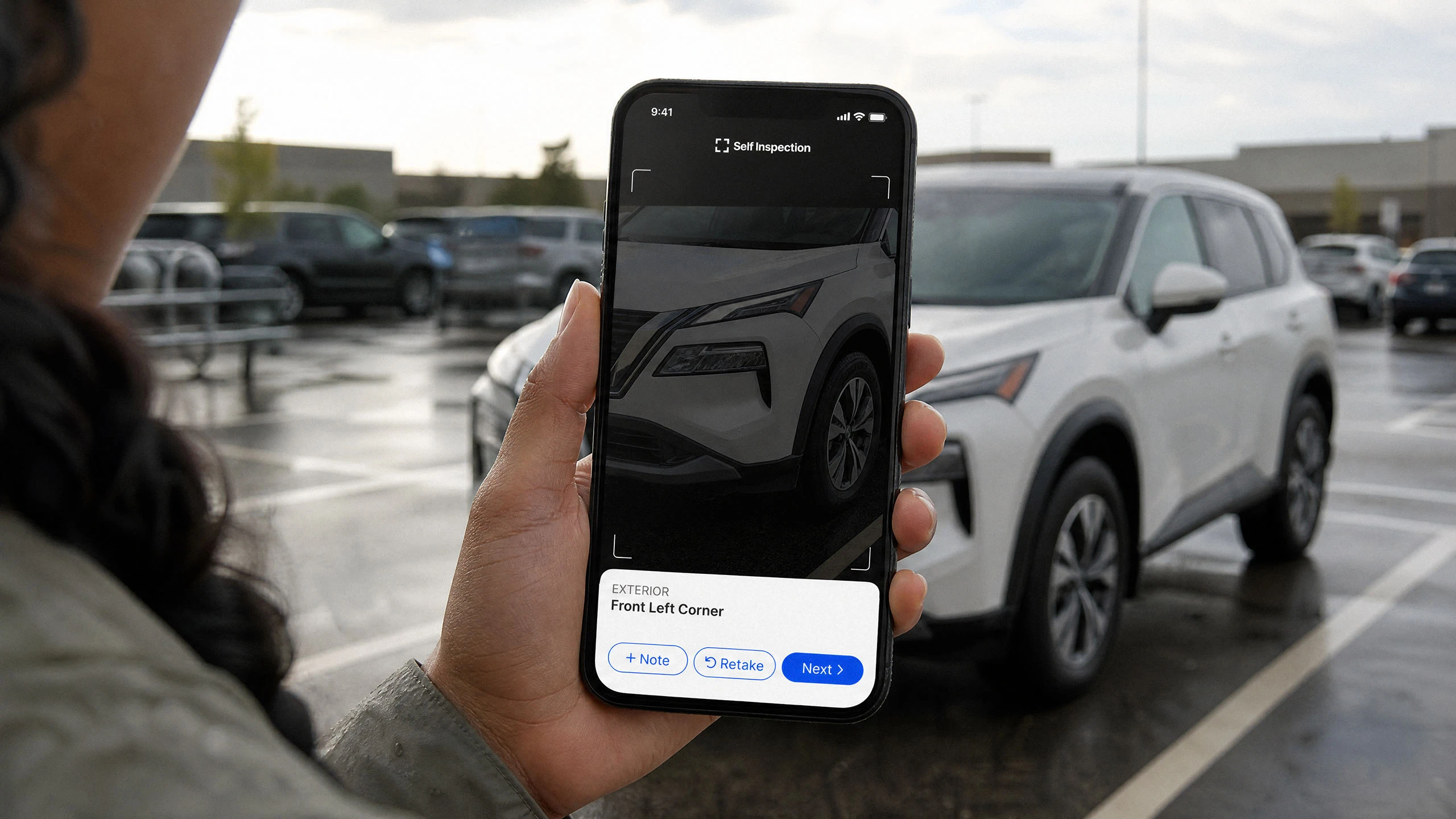
Counter agents use the same guided photo and video walkaround at each location. That creates a repeatable set of vehicle views instead of relying on different paper forms, photo folders or local habits.
2. Keep the evidence in one place
Photos, videos and agent annotations are stored as a centralized condition record. That gives teams a common reference when a vehicle moves between locations or when a return has to be reviewed later.
3. Keep damage review in-house
Avis Alaska agents continue to flag damage themselves from the captured imagery, and repair cost estimation remains an internal task. Self Inspection standardizes the capture and record without replacing the operator's decision process.
From pilot to statewide standard.
The program expanded across all 12 counters, ran through a full peak season and became the default check-out and return workflow.
| When | Milestone | What changed |
|---|---|---|
| Mar 6, 2024 | Pilot launch | First live inspection completed at an Avis Alaska counter. |
| 2024 | Statewide rollout | Workflow validated and rolled out across all 12 statewide counters. |
| 2025 | First full year | First full peak tourist season at statewide scale; daily volume stabilized. |
| 2025 | Employee-owned | Avis Alaska transitioned to 100% employee ownership while the inspection workflow continued. |
| 2026 | Default workflow | Standard check-out and return workflow in place at every Alaska counter. |
| Jun 23, 2026 | 121,746 total | Program reached 121,746 inspections at roughly 145 inspections per day. |
What changed
More than two years of program data show a statewide operating standard, high inspection volume and a much shorter capture process against a manual inspection benchmark.
From March 6, 2024 through June 23, 2026, Avis Alaska completed 121,746 inspections across 12 statewide locations. Average inspection time was 6 minutes 40 seconds, compared with a 30 to 45 minute manual inspection benchmark.
Using that benchmark, the program estimates roughly 62,500 counter hours saved over the period. By 2026, the workflow had become the default check-out and return process across the network, while damage assessment and repair-cost estimation remained in-house.
The vehicle can change locations. The condition standard should not.
For Avis Alaska, the outcome was bigger than moving a walk-around onto a phone. The business created one repeatable way to document vehicle condition across a geographically distributed rental network, giving every counter a clearer record to work from while keeping operational judgment with the team.
More case studies
All case studies

Lease-end could not depend on where a member lived.
Credit Union - indirect leasing program
51,557Inspections delivered
Read case study
A high-touch lease needs a clear condition record at return.
Admiral Leasing - full-service vehicle lessor (U.S.)
Read case study
The last manual step in a digital operation.
Auto360 Limited - UK commercial vehicle rental & repair
802Inspections delivered
Read case studyReady to get started?
Streamline lease returns, reduce disputes and accelerate remarketing readiness - all from one simple platform.